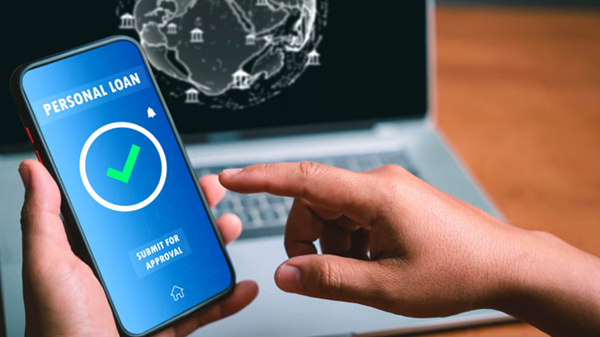
When you apply for a personal loan through an app, you hand over some of your most sensitive information: your Aadhaar number, PAN, bank statements, salary details, and more. In a matter of minutes, this data travels from your phone to the lender’s servers, gets checked against government databases and credit bureaus, and forms the basis of a decision worth lakhs of rupees. For most borrowers, this entire process is invisible. You tap “Submit” and wait, with little idea of where your data goes or how it is protected.
That invisibility is exactly why data security deserves attention. The difference between a regulated personal loan app and an unregulated one is not just the interest rate, it is what happens to your personal information behind the screen. Understanding the journey your data takes, and the protections that should surround it, helps you distinguish a safe application from a risky one. Here is what actually happens to your data during a personal loan application.
The Data You Share and Why It’s Needed
A personal loan application collects specific categories of data, each serving a defined purpose in verifying your identity and assessing your creditworthiness:
- Identity data: Your Aadhaar number and PAN, used to confirm you are a real, verifiable person and to pull your credit report.
- Financial data: Bank statements, salary details, and existing obligations, used to assess your income and repayment capacity.
- Contact data: Your mobile number and email, used for OTP verification and communication.
- Employment data: Employer name and income, used to evaluate stability and eligibility.
Every one of these has a legitimate underwriting purpose. The test of a trustworthy loan app is whether it collects only what it genuinely needs, and nothing more. An app that also demands access to your contacts, photo gallery, or call logs is collecting data with no lending purpose, which is a clear warning sign covered in detail below.
The Journey Your Data Takes During an Application
When you submit an application, your data moves through a sequence of verification steps, most of them automated and completed in seconds.
First, your identity is verified through Aadhaar-based eKYC. Your Aadhaar number is checked against the UIDAI database via an OTP sent to your registered mobile, confirming your identity, address, and photograph without any physical document changing hands. Simultaneously, your PAN is validated against Income Tax Department records.
Next, your PAN triggers a credit bureau pull. The app retrieves your credit report from CIBIL or another bureau, reading your score, existing loans, and repayment history. Then your financial data is assessed, either through bank statements you upload or, more securely, through the Account Aggregator framework, which pulls verified bank data directly from your bank. Finally, all of this feeds the lender’s underwriting system, which produces a decision. Throughout, your data should be encrypted in transit and at rest.
The Account Aggregator Framework: A More Secure Path
One of the most significant security improvements in digital lending is the Account Aggregator (AA) framework, regulated by the RBI. It changes how your financial data reaches the lender in a way that directly benefits your security.
Under the traditional method, you download your bank statements as PDF files and upload them to the loan app. These files sit on your device and the lender’s servers, and their authenticity has to be separately verified. The AA framework replaces this entirely. Instead of handling files, you grant consent for the lender to receive verified transaction data directly from your bank through a secure, encrypted digital pipeline.
The security advantages are real. There are no PDF files to be intercepted, forged, or stored insecurely. The data flow is consent-based, meaning you explicitly authorise exactly what is shared and for how long. And because the data comes straight from your bank, its authenticity is guaranteed. When a loan app offers the AA option, using it is the more secure choice.
What RBI Rules Require Lenders to Do With Your Data
The RBI’s Digital Lending Directions impose strict data-protection obligations on every regulated lender and loan app. These rules exist precisely because earlier abuses, data harvesting, unauthorised sharing, and harassment, were widespread among unregulated apps. The key requirements:
- Data minimisation: A loan app can collect only the data needed for the specific loan. It cannot demand access to your contacts, call logs, photos, or media files, because these serve no lending purpose.
- Purpose limitation: Data collected for your loan cannot be used for unrelated purposes like marketing without your separate, explicit consent. Your loan application consent does not cover cross-selling.
- Data localisation: All borrower data must be stored on servers located within India. If any data is processed abroad, it must be deleted from foreign servers within 24 hours.
- Consent-based collection: You must be told what data is being collected and why, and your consent must be explicit rather than assumed.
Under the Digital Personal Data Protection Act, 2023, you also have the right to request deletion of your personal data once your loan is fully repaid. These protections apply to every regulated lender, including large NBFCs like Bajaj Finance, which operates the Bajaj Finserv personal loan app under this framework.
The Permissions Red Flag: What a Loan App Should Never Access
The single clearest indicator of an unsafe loan app is the permissions it requests. Under RBI rules, no digital lending app can access your contact list, call logs, photo gallery, or media files. There is no legitimate credit-assessment reason for a lender to read your contacts or view your photos.
The reason this matters so much is historical. Unregulated apps demanded these permissions specifically to weaponise the data, harvesting contact lists to harass borrowers and their families during collection, or accessing photos to threaten borrowers with morphed images. The RBI banned this access outright.
Legitimate loan apps request only what they functionally need: camera access to capture KYC documents, location for fraud prevention, and your phone number for OTP delivery. Before installing any personal loan app, check its permissions in the Play Store or App Store listing. If it asks for contacts, gallery, or SMS access, do not install it, regardless of how attractive the loan offer looks.
How to Verify a Loan App Is Safe Before Sharing Data
Protecting your data starts before you enter a single detail. A short verification routine filters out the apps that pose a risk:
Check the RBI DLA directory. Every legitimate loan app must be listed on the RBI’s Digital Lending Apps directory at rbi.org.in. If the app is missing, do not share your Aadhaar, PAN, or any financial data with it.
Identify the regulated lender. A safe app clearly names the bank or NBFC funding the loan. The Bajaj Finserv app, for example, is clearly operated by Bajaj Finance Limited, an RBI-registered upper-layer NBFC. If no regulated entity is named, treat the app as unsafe.
Review permissions before installing. Contacts, gallery, call logs, and SMS access are red flags. Camera, location, and phone number are acceptable.
Look for the privacy policy. A legitimate app has a clear, accessible privacy policy explaining what data it collects, how it is used, and how it is stored. Its absence is a warning sign.
Prefer the Account Aggregator option when available, as it keeps your financial data flowing through a secure, consent-based channel rather than uploaded files.
Your Rights Over Your Data
As a borrower, you are not a passive party in this exchange. The regulatory framework gives you specific rights over your data:
- The right to know what data is collected and for what purpose, disclosed before you consent.
- The right to consent explicitly to data collection, and to withhold consent for uses beyond the loan itself.
- The right to data localisation, ensuring your information stays on Indian servers.
- The right to erasure under the DPDP Act, allowing you to request deletion of your data after the loan is repaid.
- The right to grievance redressal through the lender’s designated Nodal Grievance Redressal Officer, whose details must be displayed on the app, and escalation to the RBI if needed.
Knowing these rights lets you hold a lender accountable if your data is mishandled. A regulated loan app is bound to honour them; an unregulated one operates outside their reach entirely, which is the whole reason to stay within the regulated system.
The Bottom Line
During a personal loan application, your most sensitive data, identity, financial, employment, travels through a series of automated verification steps in a matter of minutes. When you use a regulated personal loan app, that journey is protected by encryption, data minimisation, localisation, and consent requirements enforced by the RBI. When you use an unregulated one, none of those protections apply, and your data becomes the product rather than the input.
The safeguard is entirely in your hands before you apply. Verify the app on the RBI’s DLA directory, confirm the regulated lender behind it, check that it does not request access to your contacts or gallery, and use the Account Aggregator option where available. A regulated personal loan app like Bajaj Finserv handles your data within a framework built to protect it. The five minutes you spend verifying an app before sharing your details is the most important security step you can take.